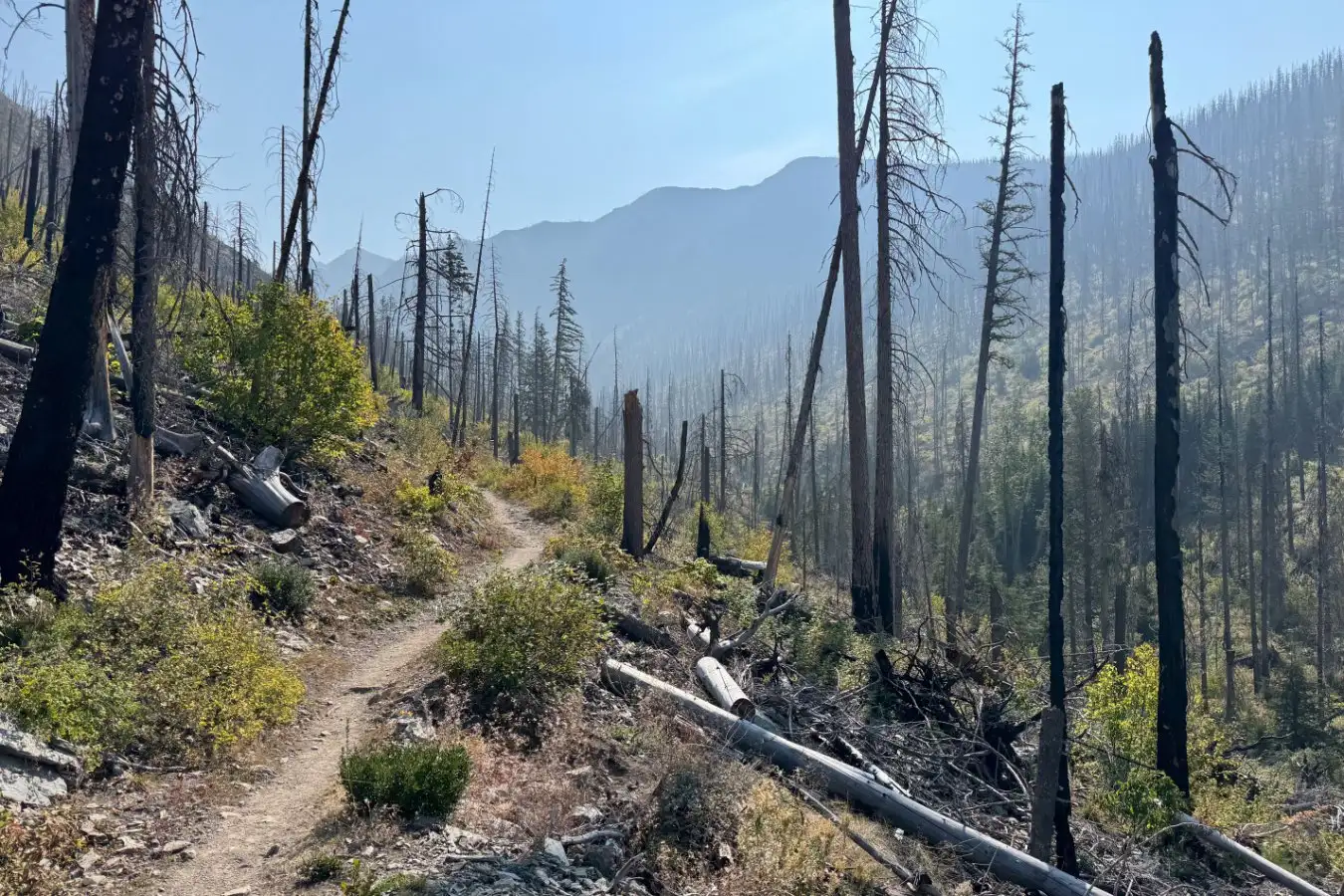
Charred trees still standing after a wildfire in Glacier National Park, Montana
Gorski/NurPhoto/Shutterstock
In 2021, a smouldering underground coal seam ignited the tinder-dry grass and brush in Poverty Flats, Montana, setting off a wildfire that burned 267 square kilometres. The blaze killed 50,000 trees, mostly ponderosa pines, that had shaded cattle grazing on the Gentry Ranch.
Black, partially burnt snags stood across a moonscape of charred earth. These “widowmakers” could have unpredictably toppled onto workers or cows, or fuelled the next wildfire. Standard practice would have been to burn the trees in piles, emitting almost 7000 tonnes of carbon dioxide.
Instead, bulldozers and logging machines with giant claws dumped the trees into a 5000-square-metre pit and covered them over with 6 meters of soil and gravel and a polypropylene fabric. The company running the operation, Mast Reforestation, says this way the trees won’t decompose for centuries, preventing more global warming and making another fire less likely. Mast can also sell carbon credits to pay for planting new trees.
“By no means do we consider this a silver bullet – it requires all of the other pathways that are out there – but for forests, this is a very, very strong tool,” says Mast CEO Grant Canary.
The United Nations climate body says to compensate for hard-to-abate emissions, humanity will need to remove CO2 from the atmosphere with techniques like planting trees, building air-filtering machines or adding alkalis to the ocean. Because plants and trees absorb CO2 when they grow and emit it after they die, startups have been charring forestry and agriculture waste to make biochar and spreading it on fields, compressing it into bricks to store underground, or turning it into bio-oil to inject into old oil wells.
Mast has expanded this to wood killed by wildfires, which are now burning 10 times more of the western US than 40 years ago. The west is bracing for another brutal fire season after a record heatwave led to a record-low snowpack this spring.
Up to 99 per cent of a tree’s mass can remain after it’s killed by fire – although the amount varies widely – and about half that mass is carbon. For the Gentry project, Mast weighed the dead trees on lorries at a weighbridge and calculated almost 7000 tonnes of CO2-equivalent mass based on nitrogen and moisture content. It subtracted the machinery’s CO2 emissions and an estimate of a small amount of potential tree decomposition to sell 4277 credits verified by the Puro.Earth registry, each representing 1 tonne of CO2 removal.
For large-volume purchases, a credit from Mast can cost under $200, more than a credit for planting trees, but near the price of a biochar credit.
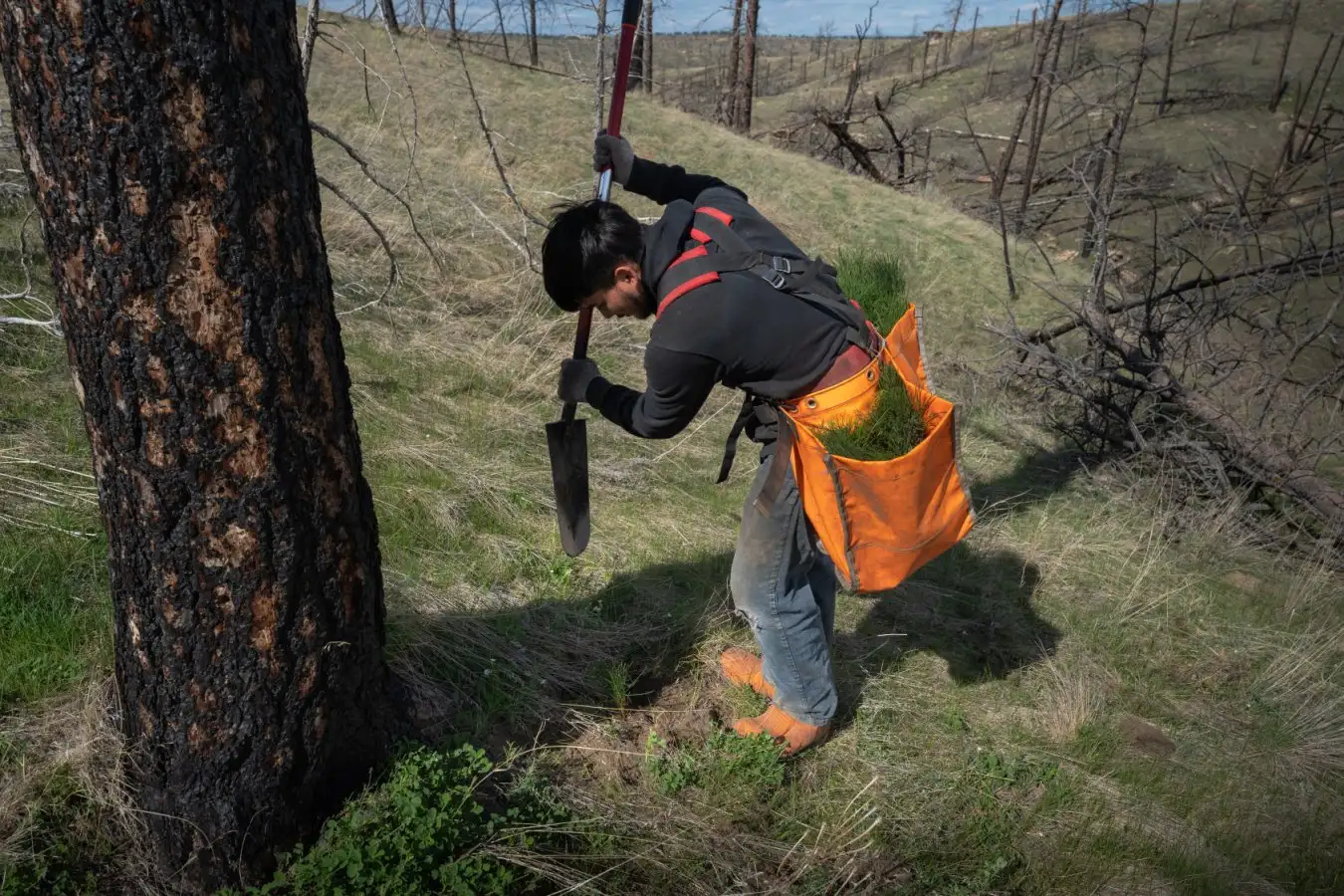
Ponderosa pine seedlings were planted on an eastern Montana property burned by wildfire
Mast Reforestation
Mast spent part of the profits to raise seedlings and plant them on the ranch, while saving the owners the high cost of pile burning. Montana alone holds 6.5 million tonnes of accessible fire-killed trees, according to Canary, who is preparing a second project and plans to bury 150,000 tonnes annually by 2030. “There’s a lot of tonnes to be put underground,” he says.
The Puro.Earth standard says buried biomass can sequester carbon for 100-plus years. In 2022, scientists dug up a cedar log east of Montreal, Canada, that had lost only 5 per cent of its carbon after being buried for 3775 years. But wood can start decaying in months if it’s buried in the wrong conditions.
The fungi and bacteria that decompose wood need oxygen, moisture and warmth to survive. If you can seal the wood off from oxygen in the air, you can kill off these organisms, says Ning Zeng at the University of Maryland, who found the log near Montreal. At least 1 metre of clay-rich soil can typically keep air out.
While soil in the western US is mostly rocky and doesn’t have as much clay as the eastern US, glacial tills or other impermeable soils can often still be found within a reasonable distance of burnt areas, according to Zeng. But we need more research on how well different conditions preserve wood, he says.
“I’m very happy to see those commercial projects being implemented, but how to do it right is a key question,” says Zeng. “The implementers may not know, nor can scientists right now give actually a very clear-cut answer.”
If buried trees accidentally decompose, a project could potentially increase emissions because it burns fuel to dig the vault and move the trees there. Excavation can also kill plants and release soil carbon, although keeping the topsoil intact and placing it back on top can reduce that disturbance, says Zeng.
In a wrongful termination lawsuit, a former employee accused Mast of exaggerating the value of carbon credits it was selling from reforestation projects that did not involve deadwood burial. Mast says the lawsuit has been resolved and has not affected its operations.
Topics:
Source link : https://www.newscientist.com/article/2526532-will-burying-dead-trees-after-a-wildfire-keep-their-carbon-locked-up/?utm_campaign=RSS%7CNSNS&utm_source=NSNS&utm_medium=RSS&utm_content=home
Author :
Publish date : 2026-05-14 14:00:00
Copyright for syndicated content belongs to the linked Source.