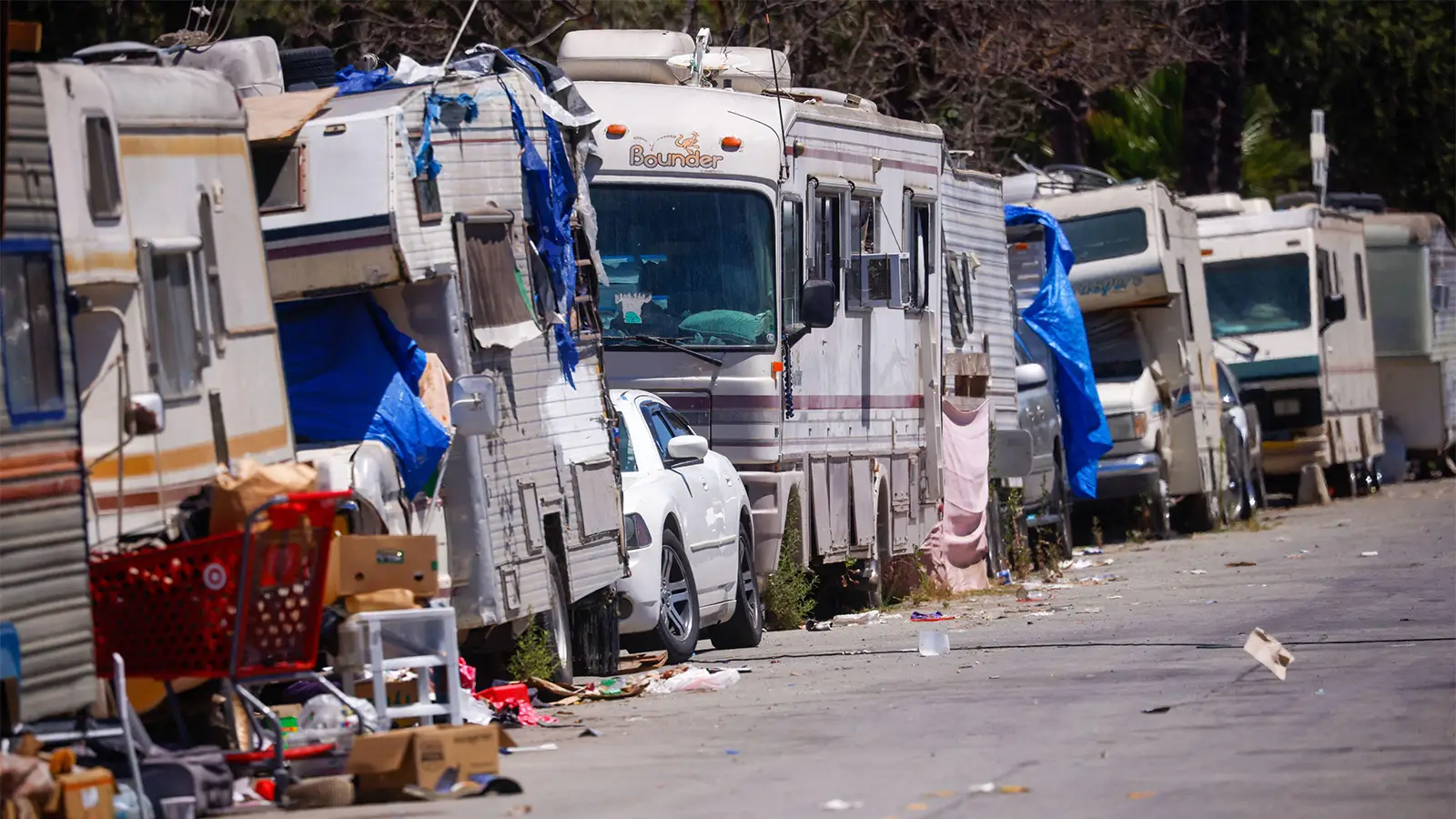
Every Saturday for the past year, I’ve visited Patty*, a 63-year-old woman experiencing chronic homelessness, in the Columbus Park encampment in San Jose. As president of the Stanford Medicine Outreach Program, I lead a group of medical students and volunteer clinicians; we distribute harm reduction products, sexual health and menstrual health products, and toiletry kits, and we conduct health screenings for people experiencing homelessness. Patty is the self-proclaimed mayor of the encampment, which is home to almost 400 people.
More than 10,000 people in Santa Clara County experience homelessness on any given night. The majority live unsheltered, like Patty. As a future physician, I know I will care for unhoused patients whose health is shaped by violence, trauma, and poverty. But medical training still teaches us to treat disease in isolation, far from the conditions that cause it.
Homelessness is not only a housing issue; it is a public health crisis, one that medical education does not prepare future physicians to contend with.
I don’t know all the names of the hundreds of people who call the Columbus Park encampment home, but I always look forward to seeing them. There’s the 60-something-year-old man who reminds me of Santa Claus and always offers to help unpack the supplies from our outreach van. There’s the short-haired woman who prefers tampons to pads and jokes about rounding down her age on our intake form. There’s the couple that lives out of their minivan with a black pit bull that looks just like mine.
I was haunted by images of my first trips to the encampment. For days after, I saw faces peeling from untreated infections, gums filled with pus after emergency tooth extractions, skin covered in unhealed abscesses, and people carrying everything they owned waiting in line for their first shower in weeks.
At Haven Family House, a LifeMoves shelter on the border of Atherton (the richest town in the U.S.) and East Palo Alto, the stories are no different.
Elena* escaped an abusive husband to protect her three children. When I asked what she needed most from the healthcare system, she told me her kids came first — but she wished she could access mental health care. She still blamed herself for her situation. When I shared my own experiences with trauma and healing, we cried together. Later, when she mentioned concerns about her teenage daughter’s relationship, I worked with our team to develop a teen dating violence prevention session.
Then there is Carlos*. I met him at a hot meal distribution site. He lives with severe cardiovascular disease and advanced lymphedema, carrying everything he owns on his walker. His legs are swollen with open wounds that cause constant pain.
His condition is worsened by homelessness in ways I had never considered. Because of limited mobility, Carlos sleeps upright on a bus bench, making fluid pool at the bottom of his legs. Every day since August, a community partner has cleaned and rewrapped his wounds. When she is away, a friend and I help. From his cheery demeanor, you would never guess that he spends most of his days outside a senior center.
When I shared Carlos’s case with a class I teach, I asked: why aren’t we pursuing a long-term medical solution, instead of changing his bandages every day? The answer revealed something we rarely learn in medical school.
Carlos needs a wound vacuum — a negative pressure device that drains excess fluid and helps close open wounds. But because Carlos is unhoused, he cannot safely use the wound vacuum: the risk of infection is too high. For him, housing is not a social issue. It is a medical prerequisite.
Before this work, I had never really conversed with someone experiencing homelessness. Like many people, I carried quiet assumptions. I kept granola bars in my car instead of offering cash, believing I knew what help should look like. But listening to Patty, Elena, Carlos, and so many others changed that perspective.
The public narrative often suggests that people are unhoused because of poor choices, that they cannot be trusted with autonomy, that they are somehow less deserving. But the stories I hear tell a different reality: a woman using substances to cope with life on the street; a mother fleeing violence; a father working full-time yet unable to afford rent; a man whose medical condition cannot be treated because he has no place to live.
Sometimes I leave the Columbus Park encampment feeling useless. I am haunted by the limits of what we can offer: a few supplies, a brief visit, a moment of comfort. I want to fix everything — the infections, the housing crisis, the suffering. But this work has changed the way I understand medicine.
Most medical training focuses on the biology of disease. What it often misses is context — housing, safety, trauma, access to food, the conditions people must survive long before they ever see a doctor. Medicine can feel fragmented, treating problems one organ system at a time, disconnected from the environments that shape health in the first place.
Every physician, regardless of specialty, will care for patients whose health has been shaped by homelessness. But understanding that reality requires more than a lecture or a textbook.
Medical schools should force us outside of classrooms, clinics, and operating rooms. Working alongside community members should be a core part of training, not an optional volunteer activity. Street medicine, shelter outreach, and community partnerships teach future clinicians something clinical rotations alone cannot: how health actually works outside the hospital. You cannot treat or prevent disease without understanding the whole human and their lived context first.
If we want doctors who treat the whole patient, we need to train them in the whole context. And that training has to begin outside of the classroom.
*Patient’s name has been changed for privacy.
Saumya Sao is a second-year medical student at the Stanford University School of Medicine and an Albert Schweitzer Fellow, a program which prepares the next generation of professionals to serve the underserved.
Source link : https://www.medpagetoday.com/opinion/second-opinions/120784
Author :
Publish date : 2026-04-14 17:45:00
Copyright for syndicated content belongs to the linked Source.