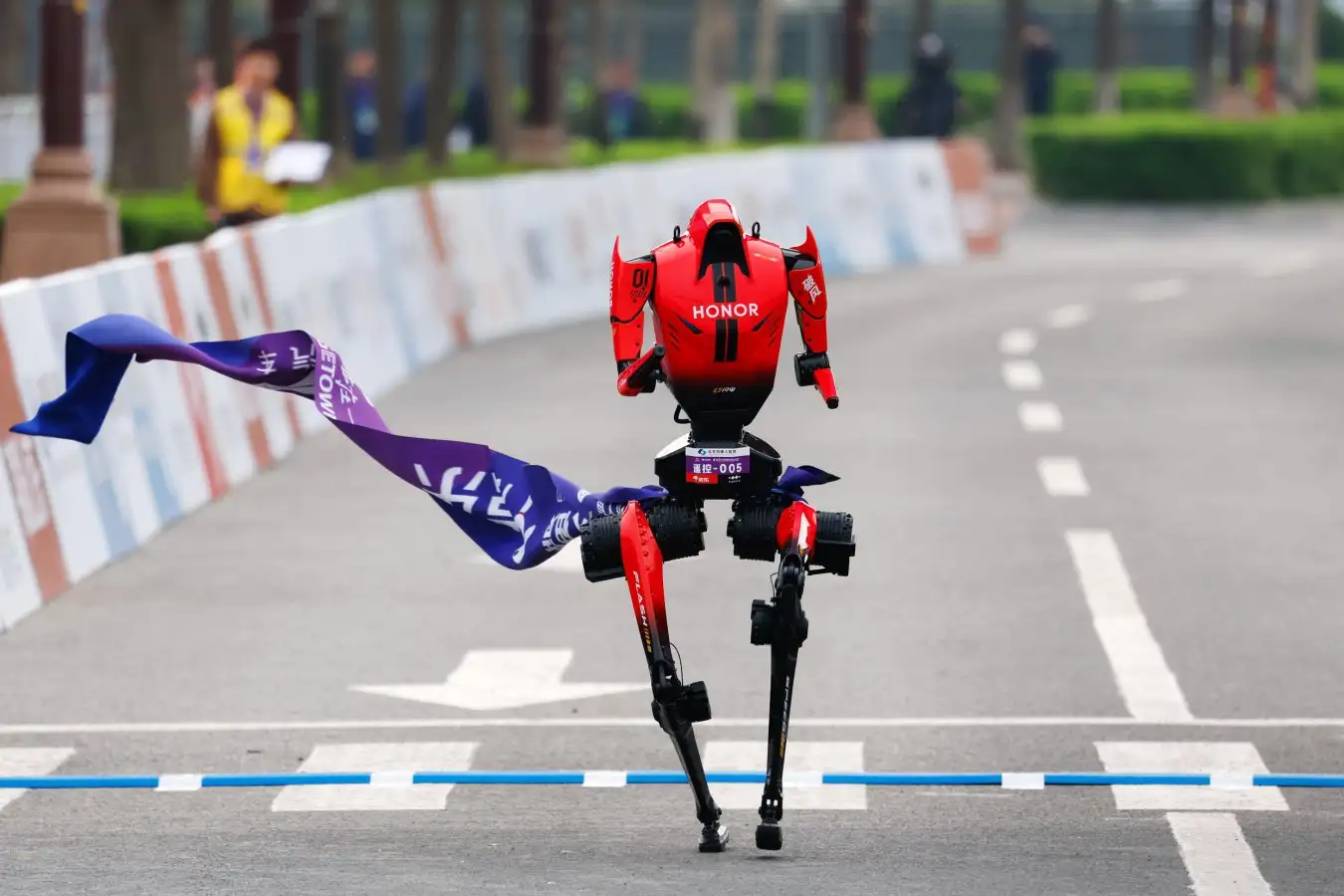
A humanoid robot from Honor crosses the finish line during the 2026 Beijing E-Town Humanoid Robot Half-Marathon
Lintao Zhang/Getty Images
Last weekend, Sabastian Sawe set a new world record with a sub-2-hour marathon, but he isn’t the only one raising the bar for runners. On 19 April, a robot from Chinese smartphone maker Honor surpassed the human record for the half-marathon. In another event this month, a robot from Unitree came tantalisingly close to the human 100-metre sprint pace. These developments raise two big questions: how much quicker can humanoid robots get, and what’s the point of fast-running robots anyway?
The inaugural Beijing E-Town Half-Marathon and Humanoid Robot Half-Marathon, where humans and robots competed on the same 21.1-kilometre course, took place in 2025. This month, the second edition saw the number of robotic teams grow nearly fivefold, with more than 100 teams bringing more than 300 humanoid robots to compete. And while the fastest half-marathon time for an autonomous robot in 2025 was 2 hours and 40 minutes, this year that fell dramatically to just over 50 minutes.
Elsewhere, robot-maker Unitree announced that its bipedal H1 model reached a record 10.1 metres per second. For context, Usain Bolt’s record time for the 100-metre distance requires an average speed of 10.44 metres per second – meaning the human record is within grasping distance.
Several factors have contributed to the rapid improvement of running robots in recent years, says Petar Kormushev at Imperial College London. There has been a dramatic reduction in the price of components, but also the emergence of higher-quality components such as stronger, more efficient motors that are quicker to react and move. Computer chips have also become faster and less power-hungry, allowing machines to run much more complex control algorithms. Communications between parts can also be faster, and sensors are smaller and more accurate.
But if speed is the aim, making robots that mimic humans is unlikely to be a winning strategy. “Humans are not that optimised for running because our primary need to survive and to evolve was not running,” says Behnam Dadashzadeh at Bournemouth University, UK. Instead, robots replicating the way an emu runs are up to 300 per cent more efficient than those designed with human-like legs, research suggests.
Dadashzadeh is unsure that making running robots will directly translate to any benefits in the home or the factory, where humanoid robots are expected to see service. If we need robots to go really fast, then we can simply fit them with wheels, he says.
While there isn’t necessarily a commercial demand for a running robot, these competitions are a good showcase, says Kormushev. “It’s like a stress test for the hardware, because you need to exert high torques on the actuators for a prolonged period of time, which can cause overheating,” he says. “The impact with the ground causes shocks to the gear boxes, and if they’re not good quality, it’s very easy to break teeth on the gears.”
It’s not unlike car-makers entering demanding rallies with rocky roads, jumps and hairpin corners. Popping to the shops won’t be as demanding, but racing reassures customers that the manufacturer knows how to make a resilient product. Neither Unitree nor Honor were available to talk to New Scientist about their motivations.
But competition can also create perverse incentives that lead to designs unsuitable for wider uses. Kormushev says the robots you see in running competitions will be highly specialised, with no working hands or face – sometimes even no head at all – and large hip joints designed purely for moving forwards at speed. “If it has to go sideways it will struggle, and any other movement may be very difficult for it because the distribution of mass and power is optimised only for forward locomotion,” he says.
That’s not to say that humanoid robots will not be useful once they become capable and cheap. A robot that looks like a human would have several advantages in a world designed for humans, such as the capability to master door handles, staircases, furniture and tools.
Just how fast can a humanoid robot go? Dadashzadeh thinks we probably aren’t far off the limit already for robots that look and work like humans. He believes that such robots will beat all human records, but not go much further. “They will be in the same scale, but robots are going to be a bit faster,” he says.
Topics:
Source link : https://www.newscientist.com/article/2523906-humanoid-robots-may-be-about-to-break-the-100-metre-sprint-record/?utm_campaign=RSS%7CNSNS&utm_source=NSNS&utm_medium=RSS&utm_content=home
Author :
Publish date : 2026-04-28 14:00:00
Copyright for syndicated content belongs to the linked Source.