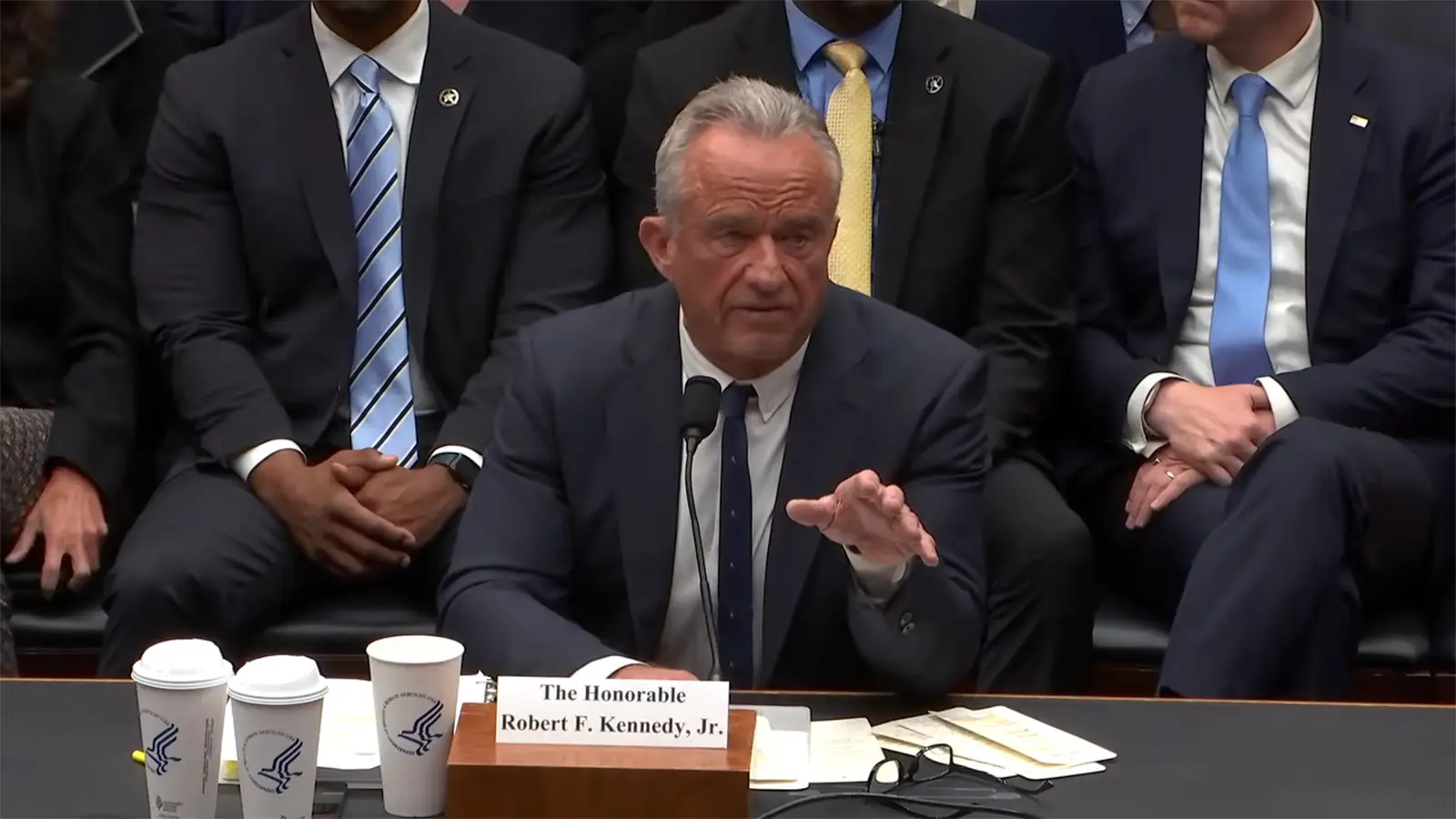
Rep. Lori Trahan (D-Mass.) during a House hearing on Tuesday expressed her frustration with HHS Secretary Robert F. Kennedy Jr., noting that he “managed to give a ‘Go Gators’ from the witness table, but not a ‘Go [vitamin] K shot.'”
Trahan was referring to the fact that Rep. Kat Cammack (R-Fla.) had persuaded Kennedy to give a shoutout to one of her home state’s college football teams, but Rep. Kim Schrier, MD (D-Mass.), had no such luck when she asked Kennedy to endorse the idea of giving all newborns a vitamin K shot.
During the House Energy & Commerce Health Subcommittee hearing on the HHS budget, Schrier said that because Kennedy had fostered an atmosphere of distrust around physicians and vaccines, “some parents are now refusing the vitamin K shot [to prevent brain bleeds] and other routine care, putting these babies at risk for bleeding out.”
“Parents don’t immunize their children or give them other routine care, and then the kids get sick and they might even die,” she added. “And right now, Secretary Kennedy, given what I just told you about vitamin K, will you just tell pregnant women out there for the record that, yes, you should get your baby a vitamin K shot?”
Kennedy responded that he had never said anything about the vitamin K shot.
“That’s exactly the point,” Schrier said. “You don’t say anything about it. But the doubt you’ve created about all of medicine and science is causing parents to make dangerous decisions.”
A literature review presented at the American Academy of Neurology meeting earlier this year found that more parents are refusing to give permission for their newborn to get the vitamin K shot.
“Vitamin K at birth is safe and effective, and while refusal is still uncommon with rates in the United States remaining under 1% in most hospitals, our review found in recent years, there have been increases in parents refusing this supplement for their newborns,” said study author Kate Semidey, MD, of Florida International University in Miami, in a statement at the time. “This trend is concerning because our review also found that babies who do not get the vitamin K injection are 81 times more likely to develop vitamin K deficiency bleeding.”
Schrier also asked Kennedy about his position on the hepatitis B vaccine for newborns. “Last week, you testified that newborns should only get the hepatitis B vaccine at birth if their moms test positive or haven’t been tested,” said Schrier, a pediatrician. “This is a massive departure from a 35-year recommendation for all babies to get the vaccine at birth.”
Noting that the hepatitis B test gives a false negative 1% to 2% of the time, she added, “That means that if there’s 100 moms out there with hepatitis B, two of them are going to be told that they don’t have it. Their children will not be vaccinated based on your recommendations, and then there’s a 90% chance that those two children will end up getting chronic hepatitis B. Mr. Secretary, do you know what happens when you get chronic hepatitis B?”
Kennedy did not answer her directly, but noted that “the death rate in children was practically zero for hepatitis B prior to the introduction of the vaccine.”
“It’s interesting [you should] say that, because generally speaking, what happens with these children is that they don’t die as children, but they can spread hepatitis B to other people, but they go on later in life to get cirrhosis of the liver and liver cancer, and they might need liver transplants, and they die prematurely when they are younger in adulthood,” Schrier said. “And so you’re basically sentencing thousands of kids to a terrible chronic illness … for no reason.”
When her turn came, Cammack fired back on the issue of shots for newborns. “I do want to just say thank you for actually [letting] moms make the best decisions for themselves and their families, rather than continuing to perpetuate the narrative that only bureaucrats in Washington can make recommendations and force people into doing things that they know is not best for them and their children,” she said to Kennedy.
Kennedy maintained that he was not against vaccinations. “I’ve never been anti-vax,” he said. “I’m putting a billion dollars into vaccine research right now at NIH and NCI [the National Cancer Institute]. If I was anti-vax, I wouldn’t be doing that. We’re developing a universal flu vaccine, and we’re developing cancer vaccines.”
“I don’t believe all vaccines are bad; I’ve never said that,” he added. “What I’ve said is they should be safety-tested. … All I’m saying is we should know the risk profile so that we can inform parents.”
Contraception also came up at the hearing. Rep. Diana DeGette (D-Colo.), the subcommittee’s ranking member, said that the Title X family planning grant program — which the Trump administration is seeking to zero out in fiscal year 2027 — provides more than 2 million low-income people access to contraceptive care, including birth control pills, IUDs, implants, and condoms, and that 8 in 10 women of reproductive age have used some kind of contraception in the last year. She asked Kennedy if he would commit “that HHS under your leadership will not take any action that will limit people [from using] the birth control method of their choice.”
“We have done more for maternal health than any administration in our history,” Kennedy said. “We have one program, the perinatal pilot program, that has already dropped maternal [deaths] by 42%” in the hospitals that have instituted it.
Rep. Mariannette Miller-Meeks, MD (R-Iowa), said that she is sponsoring a bill to make oral contraceptives available over the counter, which Kennedy said that he would support.
Source link : https://www.medpagetoday.com/publichealthpolicy/healthpolicy/120893
Author :
Publish date : 2026-04-21 21:20:00
Copyright for syndicated content belongs to the linked Source.