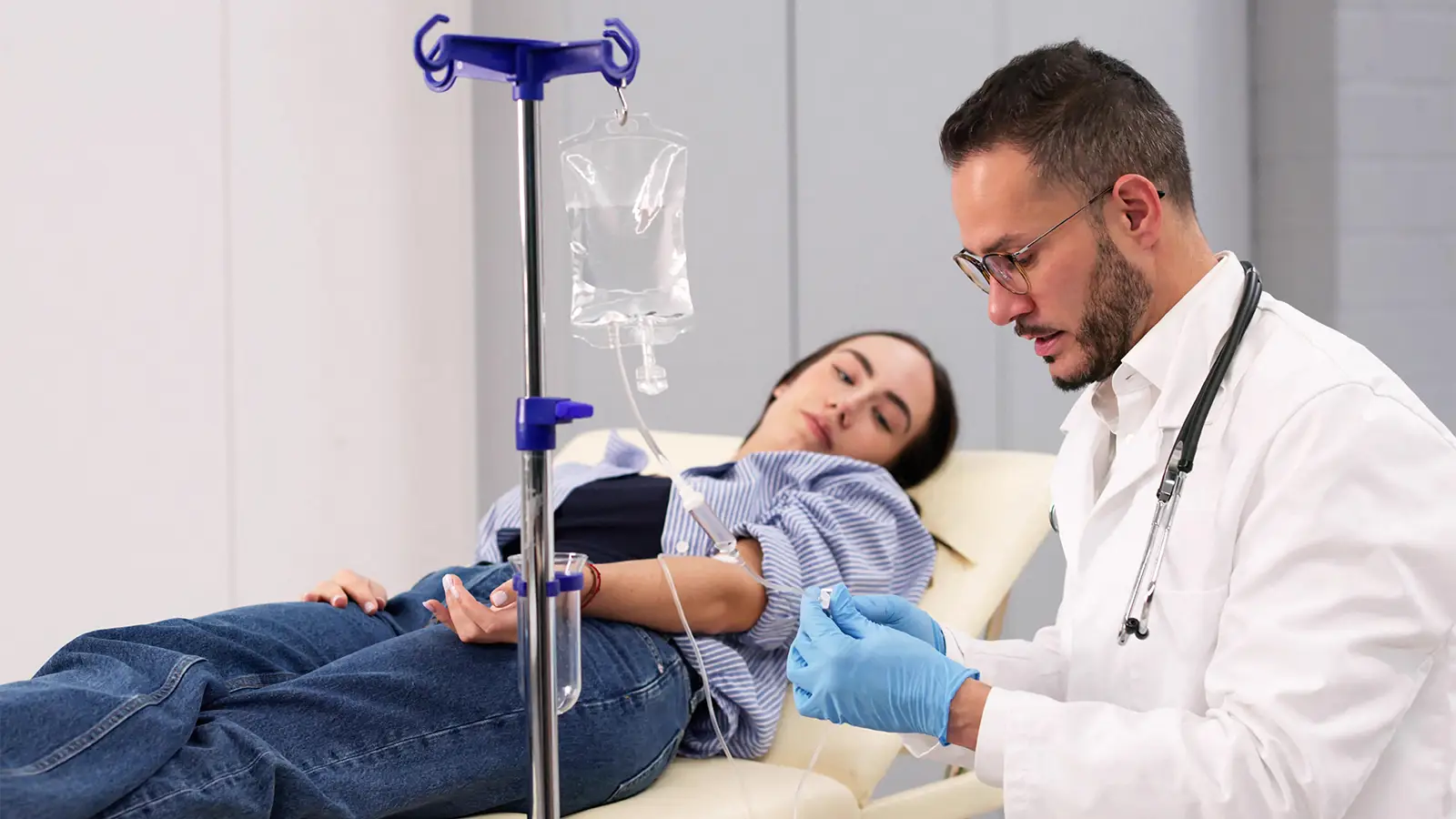
- This systematic review and meta-analysis included 26 randomized trials and assessed the effects of ketamine infusion on suicidal and depressive symptoms in patients with a major depressive episode.
- Among over 1,100 patients, those who received a single ketamine infusion had a significant reduction in suicidal symptoms compared with a control group at 24 hours and at 1 month.
- Patients with depressive symptoms who received a single ketamine infusion also had significant reductions in symptoms compared with a control group at 4 hours, 24 hours, 3 days, and 1 week.
Ketamine infusion rapidly reduced suicidal and depressive symptoms among patients with a major depressive episode, according to findings from a systematic review and meta-analysis.
Across 26 randomized trials involving over 1,100 patients, those who received a single ketamine infusion had a significant reduction in suicidal symptoms compared with a control group at 24 hours (standardized mean difference [SMD] -0.69, 95% CI -0.98 to -0.40) and at 1 month (SMD -0.70, 95% CI -1.17 to -0.24), reported Taeho Greg Rhee, PhD, of the University of Connecticut School of Medicine in Farmington, and co-authors.
Those who received repeated ketamine infusions had a similar reduction in suicidal symptoms at the end of treatment (SMD -0.72, 95% CI -1.00 to -0.43), they wrote in JAMA Psychiatry.
Patients with depressive symptoms who received a single ketamine infusion also had significant reductions in symptoms compared with a control group at several time points:
- 4 hours (SMD -1.74, 95% CI -2.43 to -1.06)
- 24 hours (SMD -1.15, 95% CI -1.58 to -0.72)
- 3 days (SMD -0.97, 95% CI -1.73 to -0.20)
- 1 week (SMD -0.89, 95% CI -1.65 to -0.13)
They also had significant reductions at the end of treatment after repeated infusions (SMD -0.81, 95% CI -1.16 to -0.46).
Rhee and team pointed to the clinical implications of this study. “First, given that the rapid antisuicidal effects occurred within the first 4 hours after a single infusion and remained effective at 24 hours, intravenous ketamine may potentially be used in emergency treatment for those at high risk of suicidal behaviors,” they wrote.
“Second, when patients with [treatment-resistant depression] are treated with intravenous ketamine, they are likely to receive repeated infusions, rather than a single infusion, because a single ketamine infusion is often short-lived and nearly all patients had relapse of their depressive symptoms within 2 weeks following administration of a single infusion,” they added.
Long-term data on the safety of ketamine — which is not approved by the FDA but is often used off-label for depression — are scarce, and studies are needed to address issues such as cognitive impairment and the drug’s abuse potential, the authors noted. A related product, esketamine nasal spray (Spravato) is FDA-approved for treatment-resistant depression and major depressive disorder with suicidal ideation, in conjunction with an oral antidepressant.
Martin Plöderl, PhD, of the Christian Doppler Clinic at Paracelsus Medical University in Salzburg, Austria, who was not involved with the study, called the effects “clinically meaningful and larger than conventional antidepressants.”
However, he told MedPage Today that most of the included studies were small and “some have implausibly large effects. This is a red flag.”
Blinding was deemed to be an issue for some randomized trials of ketamine, and Declan McLoughlin, PhD, of Trinity College Dublin, noted that in his team’s recent randomized trial of adjunctive ketamine for depression, “the vast majority of patients and raters correctly guessed the allocated treatment.”
“Unblinding contributes to expectancy bias and thereby skews the true treatment effect,” McLoughlin told MedPage Today. Despite the “hype” around ketamine, he pointed out that “large community-based outcome studies, reflecting real-world practice … have not been so promising.”
For this systematic review and meta-analysis, Rhee and colleagues searched PubMed, PsycInfo, Cochrane Library, and Embase from database inception through Nov. 7, 2025.
Randomized trials were included if participants had a diagnosis of a major depressive episode; intervention and comparator groups consisted of intravenous ketamine and controls such as saline or midazolam; and suicidal and depressive symptoms as efficacy outcomes were included.
Of the 1,166 participants included across the 26 trials, 626 received ketamine and 540 served as controls; 69.2% of trials involved a single ketamine infusion, and the rest involved repeated infusions.
In total, 80.8% of trials included patients with major depressive disorder, 11.5% included patients with bipolar depression, and 7.7% included patients with both unipolar and bipolar depressive diagnoses.
Ketamine had better response rates in depressive symptoms at 4 hours (OR 19.66, 95% CI 4.15-93.24), 24 hours (OR 7.42, 95% CI 3.00-18.34), 3 days (OR 3.56, 95% CI 1.69-7.54), and 1 week (OR 5.32, 95% CI 1.04-27.36) after a single infusion but not after repeated infusions (OR 1.74, 95% CI 0.77-3.96). However, ketamine was not significantly different in terms of remission rates.
Ten studies reported serious adverse events, including hospitalization, suicide attempts, non-suicide-related deaths, suicide, or other medical conditions, but the majority of these events were assessed to be unrelated to the interventions.
The most common adverse events in the ketamine groups were headache, cardiorespiratory issues, numbness, tingling, dissociation, nausea, dizziness, and visual disturbances, which usually resolved within a couple hours of infusion, the authors noted.
Source link : https://www.medpagetoday.com/psychiatry/depression/121147
Author :
Publish date : 2026-05-06 21:32:00
Copyright for syndicated content belongs to the linked Source.