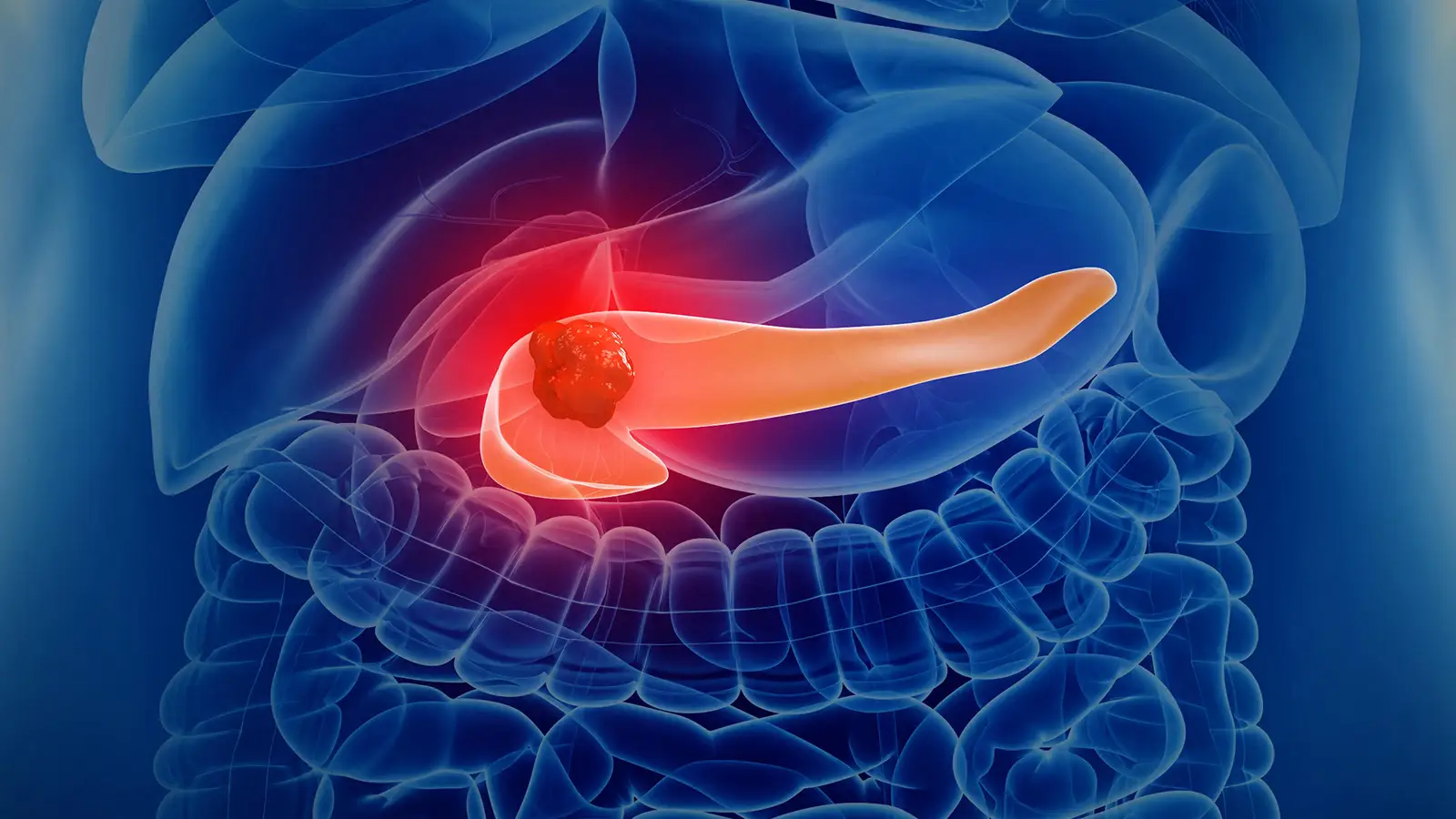
- The investigational pancreatic cancer drug daraxonrasib demonstrated promising efficacy and was associated with high-grade treatment-related adverse events in about a third of previously treated patients in a phase I/II study.
- The FDA recently said that it was allowing the drug’s maker to initiate an expanded access program, after the company announced an “unprecedented” improvement in overall survival with the drug in an ongoing phase III trial.
- The efficacy results in the current study compared favorably with current chemotherapy options for patients with previously treated metastatic pancreatic cancer.
The investigational drug daraxonrasib, now available through an early access program, demonstrated promising efficacy in previously treated pancreatic ductal adenocarcinoma (PDAC) and was associated with high-grade adverse events in about a third of patients, phase I/II data showed.
In PDAC patients with a RAS G12 mutation who received the 300-mg dose being evaluated in phase III studies, 35% responded to second-line treatment while the disease control rate reached 92%, reported researchers led by Brian Wolpin, MD, MPH, of the Dana-Farber Cancer Institute in Boston.
Responses lasted a median 8.2 months, while median progression-free survival (PFS) with the RAS(ON) inhibitor was 8.5 months and overall survival (OS) was 13.1 months.
Among the broader population of patients who received daraxonrasib at a dose of 300 mg or less, treatment-related adverse events (TRAEs) of any grade were reported in nearly all patients — most commonly rash, diarrhea, and nausea — while grade ≥3 events were reported in 30%, according to findings published in the New England Journal of Medicine.
Enthusiasm surrounding daraxonrasib has intensified recently, particularly after Revolution Medicines announced an “unprecedented” OS improvement in the phase III RASolute 302 trial. On Friday, the FDA announced that it was allowing daraxonrasib’s maker to initiate an expanded access program in collaboration with licensed prescribers.
The efficacy results in the current phase I/II study compared favorably with current chemotherapy options for patients with previously treated metastatic PDAC (response rates of less than 10%, median PFS of 2 to 3 months, and median OS of 5 to 7 months).
Along with a safety profile involving mainly low-grade adverse events, the study’s efficacy results support the ongoing phase III study, noted Wolpin and colleagues.
In a “Science Behind the Study” editorial, Channing Der, PhD, and Jen Jen Yeh, MD, both of the Lineberger Comprehensive Cancer Center at the University of North Carolina at Chapel Hill, suggested that discontinuation of treatment for disease progression in more than half of the patients in the study “highlights the need to understand the primary and adaptive mechanisms of resistance.”
“Identifying predictive biomarkers of response and rationally designing combination strategies to overcome resistance mechanisms to daraxonrasib will be essential to improving on the unprecedented responses to this single-agent small-molecule inhibitor in pancreatic ductal adenocarcinoma,” they wrote.
Two small studies of daraxonrasib, reported at the recent American Association for Cancer Research meeting, showed response rates of about 50-60% for patients with previously untreated metastatic pancreatic cancer who received the RAS inhibitor as a single agent or in combination with chemotherapy.
In explaining the rationale behind this study, Wolpin and colleagues pointed out that, considering the modest benefit achieved with current therapies, the fact that activating RAS mutations occur in more than 90% of PDAC tumors “highlights an opportunity for RAS-targeted therapies to expand treatment options for patients with PDAC and to improve patient outcomes.”
The authors included 168 patients with RAS-mutated PDAC who received at least one dose of daraxonrasib as a second-line (or later) therapy. These patients received 10 to 400 mg of daraxonrasib orally once daily, with 83 receiving the 300-mg phase III dose. Treatment was discontinued in 150 of 168 patients, most commonly because of disease progression (55%).
Across patients on all dose levels, median age was 65 years, and 45% were women. The Eastern Cooperative Oncology Group (ECOG) performance status score was 1 in 68%. All patients had stage IV disease at study entry, with liver and lung metastases in 67% and 46%, respectively.
Of the patients in the trial, 89% had RAS G12 mutations, including KRAS G12D (39%), KRAS G12V (31%), KRAS G12R (17%), and other RAS G12 (2%). Among the 19 patients with non-RAS G12 mutations, 14 had KRAS Q61H, two had KRAS Q61R, two had KRAS Q61K, and one had KRAS G13D mutations.
The median number of previous systemic therapies among all patients was two. One previous line of therapy had been administered to 42% of patients, with the remainder receiving two or more lines for metastatic disease.
Among the second-line patients with RAS G12, G13, or Q61 mutations treated at a dose of 300 mg, 29% responded and the disease control rate reached 95%. Median duration of response (DOR) was 8.2 months, while median PFS and OS values reached 8.1 months and 15.6 months, respectively.
In patients with any RAS mutation treated in the third- or later-line setting, 20% had a response, the disease control rate reached 84%, and the median DOR was 3.3 months.
Adverse events deemed by the investigators to be related to treatment with daraxonrasib were reported in 96% of patients — a majority of these events were grade 1 or 2. The most common TRAEs of any grade were rash (88%), diarrhea (46%), nausea (42%), stomatitis or mucositis (40%), vomiting (31%), and fatigue (20%).
Dose interruption for TRAEs occurred in 37%, with dose reductions in 21% and discontinuation for TRAEs in less than 1% (one patient).
Serious TRAEs occurred in 6%, with diarrhea (2%) being the most frequent. No grade 5 events were observed.
Source link : https://www.medpagetoday.com/hematologyoncology/othercancers/121148
Author :
Publish date : 2026-05-06 22:16:00
Copyright for syndicated content belongs to the linked Source.