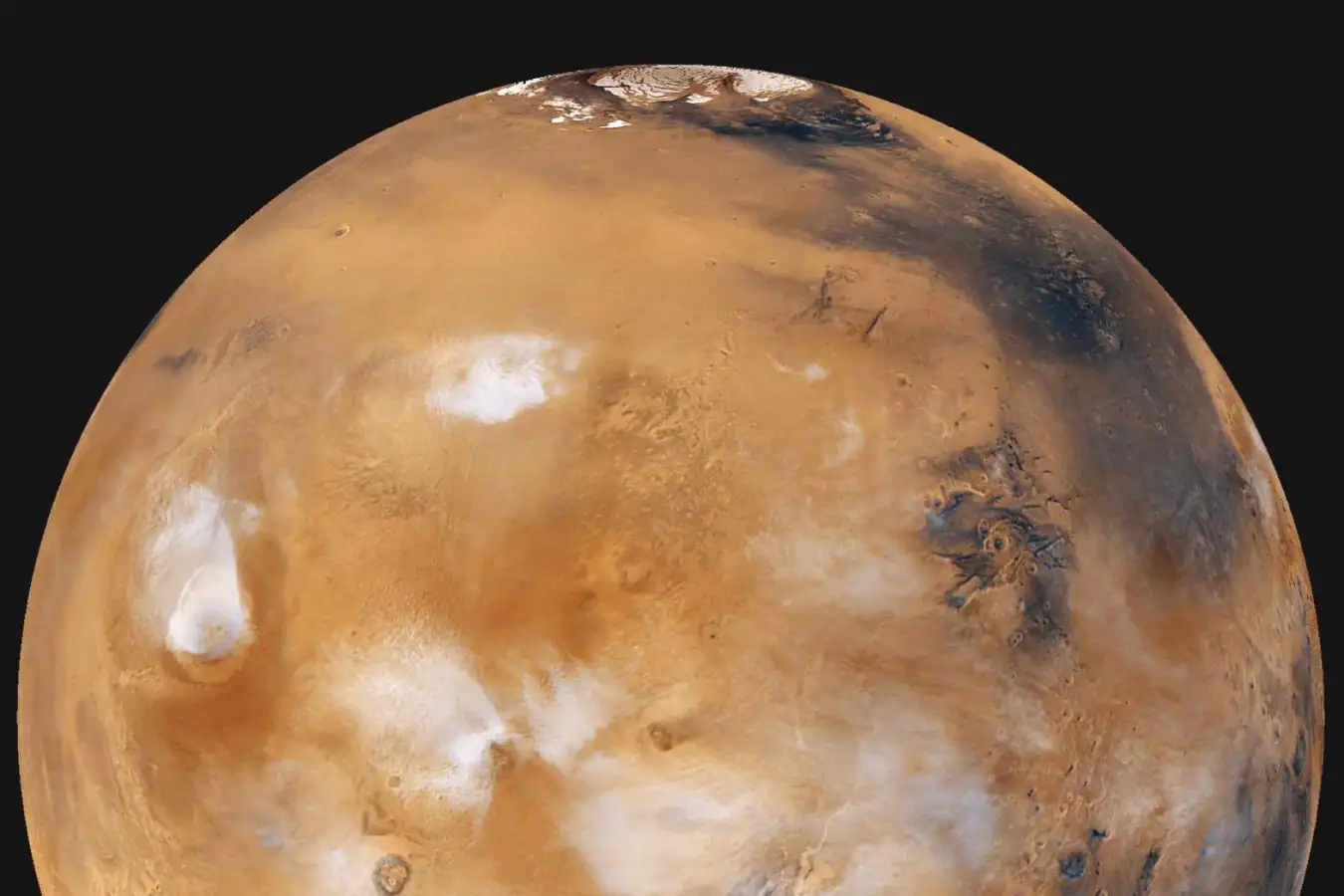
Bluish-white water ice clouds hang above the Tharsis volcanoes on Mars
NASA/JPL/MSSS
Mars was empty before we came. That’s not to say that nothing had ever happened. The planet had accreted, melted, roiled and cooled, leaving a surface scarred by enormous geological features: craters, canyons, volcanoes. But all of that happened in mineral unconsciousness, and unobserved. There were no witnesses – except for us, looking from the planet next door, and that only in the last moment of its long history. We are all the consciousness that Mars has ever had.
Now everybody knows the history of Mars in the human mind: how for all the generations of prehistory it was one of the chief lights in the sky, because of its redness and fluctuating intensity, and the way it stalled in its wandering course through the stars, and sometimes even reversed direction. It seemed to be saying something with all that. So perhaps it is not surprising that all the oldest names for Mars have a peculiar weight on the tongue – Nirgal, Mangala, Auqakuh, Harmakhis – they sound as if they were even older than the ancient languages we find them in, as if they were fossil words from the Ice Age or before. Yes, for thousands of years Mars was a sacred power in human affairs; and its color made it a dangerous power, representing blood, anger, war and the heart.
Then the first telescopes gave us a closer look, and we saw the little orange disk, with its white poles and dark patches spreading and shrinking as the long seasons passed. No improvement in the technology of the telescope ever gave us much more than that; but the best Earthbound images gave Lowell enough blurs to inspire a story, the story we all know, of a dying world and a heroic people, desperately building canals to hold off the final deadly encroachment of the desert.
It was a great story. But then Mariner and Viking sent back their photos, and everything changed. Our knowledge of Mars expanded by magnitudes, we literally knew millions of times more about this planet than we had before. And there before us flew a new world, a world unsuspected.
It seemed, however, to be a world without life. People searched for signs of past or present Martian life, anything from microbes to the doomed canal-builders, or even alien visitors. As you know, no evidence for any of these has ever been found. And so stories have naturally blossomed to fill the gap, just as in Lowell’s time, or in Homer’s, or in the caves or on the savannah – stories of microfossils wrecked by our bio-organisms, of ruins found in dust storms and then lost forever, of Big Man and all his adventures, of the elusive little red people, always glimpsed out of the corner of the eye. And all of these tales are told in an attempt to give Mars life, or to bring it to life. Because we are still those animals who survived the Ice Age, and looked up at the night sky in wonder, and told stories. And Mars has never ceased to be what it was to us from our very beginning – a great sign, a great symbol, a great power.
And so we came here. It had been a power; now it became a place.
This is an extract from Kim Stanley Robinson’s Red Mars, the latest pick for the New Scientist Book Club. Sign up and read along with us here.
Topics:
Source link : https://www.newscientist.com/article/2520296-read-an-extract-from-kim-stanley-robinsons-sci-fi-classic-red-mars/?utm_campaign=RSS%7CNSNS&utm_source=NSNS&utm_medium=RSS&utm_content=home
Author :
Publish date : 2026-03-27 09:15:00
Copyright for syndicated content belongs to the linked Source.