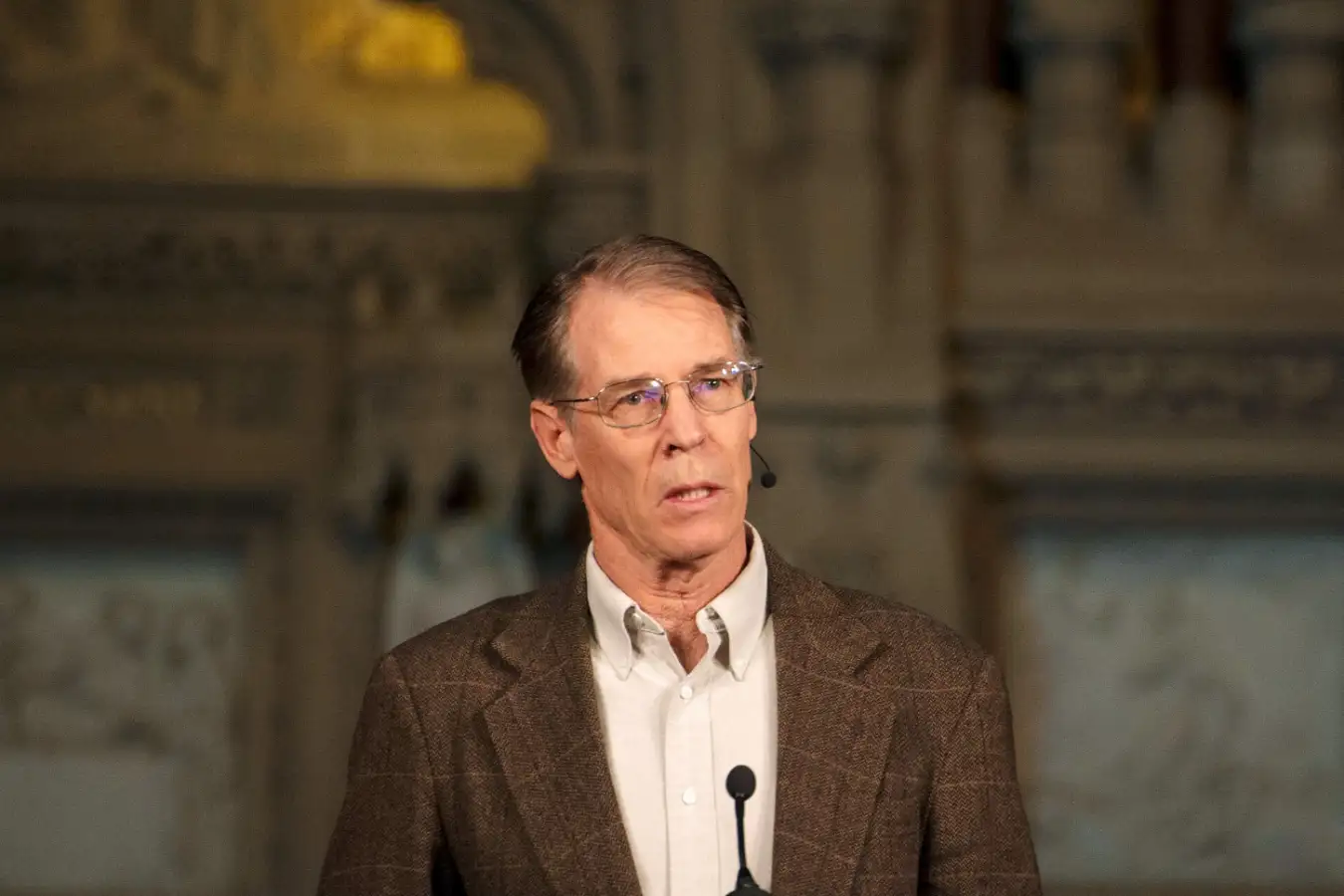
Kim Stanley Robinson, author of Red Mars
Terese Loeb Kreuzer/Alamy
2026 marks the dawn of a momentous era: humankind taking our first steps towards colonising Mars.
Later this year, NASA’s ESCAPADE probes will fly to the surface of the Red Planet, capitalising on its proximity to Earth and paving the way for crewed flights in the near-future.
Settlers may one day construct a number of self-sustaining cities, altering the barren Martian surface and allowing humans to flourish away from Earth. This will have the convenient side-effect of extending the lifespan of collective human consciousness.
It’s a scenario posed by both Elon Musk (who, in 2024, posted on X of his plans to land on Mars within two years – though his firm SpaceX has since shifted focus to the moon), and one of the most acclaimed science-fiction novels of the last century: 1992’s Red Mars by Kim Stanley Robinson.
Set in a then-future 2026, the book doesn’t rely on conflict with aliens or implausible technology for its action. The focus is instead on the infighting that occurs between the humans who believe that intelligent life is sacred and should spread, and those who maintain that the solar system must remain largely undisturbed.
In terms of accurately imagining the future, author Robinson made some lucky picks. According to his novel, Earth in 2026 will be dominated by “transnationals”, all-powerful corporations who preside over every facet of human activity. The United Nations is reduced to playing second fiddle to them: “It could not succeed against their desires and would probably never try, as it was their tool,” writes Robinson.
His vision shares traits with an earlier prediction made by Pulitzer prize-winning science writer David Dietz. When asked to describe 2026 back in 1926, Dietz imagined widespread and rampant over-cultivation of resources, warning that “Competition will be keener, prices higher and luxuries fewer”.
Robinson used Red Mars to show future humans exploiting the environment as well as each other. Climate change is depicted as one of the drivers in prompting humankind to leave Earth, with central character Ann Clayborne viewing Mars as a fresh start – not just another resource to be picked dry. “You can’t just wipe out a three billion-year old planetary surface,” she remarks as the landing party discuss terraforming.
Another settler, Frank Chalmers, recalls the death of Earth’s coral reefs and panicked attempts to fertilise the Antarctic Ocean. His descriptions bear similarities with today’s proposed “climate megaprojects”, such as glacier stabilisation efforts and the re-greening of the Sinai peninsula.
Red Mars continues a trend seen in older speculative fiction, such as H.G. Wells’s The Time Machine from 1895, through its portrayal of a population divided. The “hundred” sent to the Red Planet are at loggerheads over how best to cultivate their new homeland, a theme further explored in the book’s two sequels, Green Mars and Blue Mars.
Ann expresses concern over making the Martian air breathable for fear of harming any potential undiscovered native life: “It’s unscientific, and worse, it’s immoral,” she remarks.
Her character’s very human approach to a fantastic dilemma is one of the reasons why Red Mars is today held in high regard. The book received both Nebula and British Science Fiction Association awards, and never-quite-realised TV adaptations have been announced at various times (Terminator and Titanic director James Cameron was at the helm of one before instead working on his Avatar universe).
Red Mars’ prequel novella – also called Green Mars – was even included on a CD placed aboard NASA’s Phoenix lander for its journey to the red planet in 2006, much to the delight of Robinson himself.
The author made further grounded guesses at the future in his writing outside of the Mars trilogy. He has also warned of the dangers of autocratic politics as well as pursuing technology in ways that aren’t inclusive.
In 2012, he published 2312, a novel that imagined an overheated Earth, catastrophic sea-level rise and a dismissal of our own era as “the Dithering”, in reference to humankind’s slow response to the current climate emergency.
In the same year, he spoke at the San Francisco Humanity+ Conference, addressing the excitement around using pioneering technologies such as AI to overcome our problems. “[It] maybe has to be All People Plus,” he said, implying that tension between the haves and the have-nots is another potential challenge – one a lot closer to home than our neighbouring planet, 225 million kilometres away.
The New Scientist Book Club is currently reading Kim Stanley Robinson’s Red Mars. Sign up and read along with us here.
Topics:
Source link : https://www.newscientist.com/article/2521097-why-kim-stanley-robinsons-red-mars-is-still-a-classic-34-years-on/?utm_campaign=RSS%7CNSNS&utm_source=NSNS&utm_medium=RSS&utm_content=home
Author :
Publish date : 2026-03-27 09:15:00
Copyright for syndicated content belongs to the linked Source.