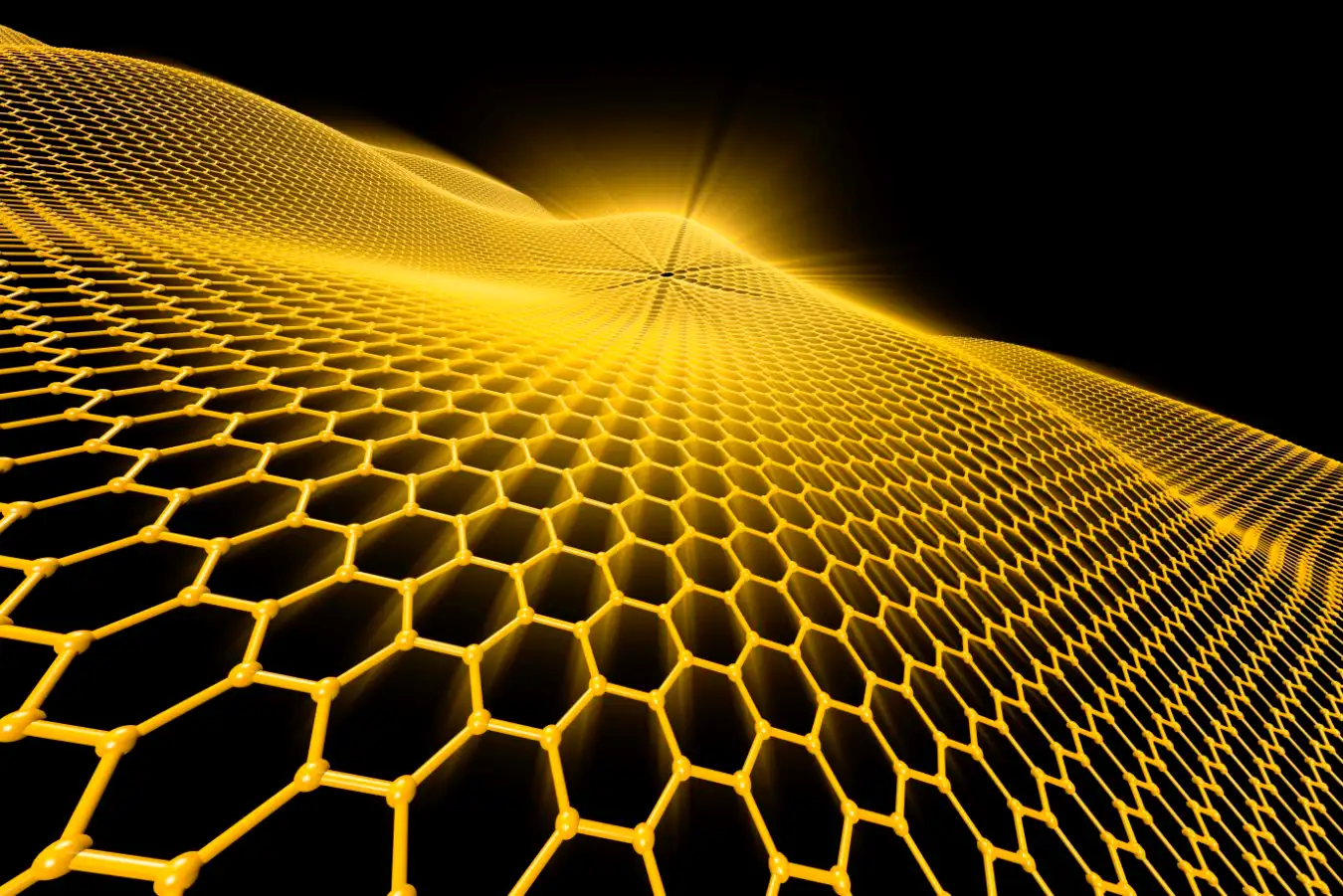
A graphene sheet is 2D – but some thin materials may not fit neatly into that category
ALFRED PASIEKA/SCIENCE PHOTO LIBRARY
A new quantum state of matter behaves as if it doesn’t fully belong to a world with two or three dimensions of space, revealing a previously unobserved way for electrons to move.
Physicists categorise states of matter based on how electrons move within a material. This motion depends on many factors, such as the arrangement of the material’s atoms.
When a thin material is immersed in a magnetic field, its electrons trace tiny circles, and any stream of them is pushed to the material’s side. This is known as the Hall effect. For materials that are magnetic, electron choreographies become more complex, giving rise to different versions of this effect.
Lei Wang at Nanjing University in China and his colleagues unexpectedly discovered a new version of this phenomenon, which they call the transdimensional anomalous Hall effect (TDAHE).
The team was studying electrons in a thin material made from carbon atoms arranged in a pattern of rhombuses in hopes of seeing them form perfectly efficient currents. But when they immersed the material in a magnetic field, the electrons reacted oddly.
“TDAHE came about as a complete surprise, a phenomenon never seen in any other material before, nor does any theory predict that,” says Wang. “After we measured the raw data, we spent about one year [trying] to understand it.”
Specifically, what stumped the researchers was that their material exhibited a type of Hall effect when they applied two different, mutually perpendicular magnetic fields. This means the electrons could execute looping motions both horizontally and vertically, even though the material was supposed to be too thin to accommodate both.
Wang says he and his colleagues initially thought some experimental error was to blame, but several follow-up experiments kept confirming that their measurements were correct. Making and testing more samples of the materials showed the same. They had to conclude that for pieces of their carbon material between 2 and 5 nanometres thick, the electrons were simply doing something new.
Because these thicknesses don’t make the material fully two- or three-dimensional, the team named the new electronic state accordingly. It doesn’t somehow bridge two- and three-dimensional realms, says Wang. “It is also not a little bit of 2D and another little bit of 3D. By using ‘transdimensional’, we want to express that there exists a new regime, which does not belong to previously well-studied 2D or 3D cases,” he says.
Andrea Young at the University of California, Santa Barbara, says that what sets the new state apart is that the mathematical representation of the electrons’ states lacks symmetry in three different ways, which is novel compared with similar states. In his view, this is more of a defining feature than the dimensionality of the material – its thickness is just a means to an end, he says.
Young says the new state can be thought of as a type of “quarter-metal”, or a metal where the lack of symmetry limits what the electrons can do compared with more conventional metals.
Wang’s team now wants to look for what they term transdimensional physics in other materials and to use more instruments, such as diamond-based magnetic field sensors, to learn more about the new state.
Topics:
Source link : https://www.newscientist.com/article/2524690-weird-transdimensional-state-of-matter-is-neither-2d-nor-3d/?utm_campaign=RSS%7CNSNS&utm_source=NSNS&utm_medium=RSS&utm_content=home
Author :
Publish date : 2026-04-29 16:00:00
Copyright for syndicated content belongs to the linked Source.