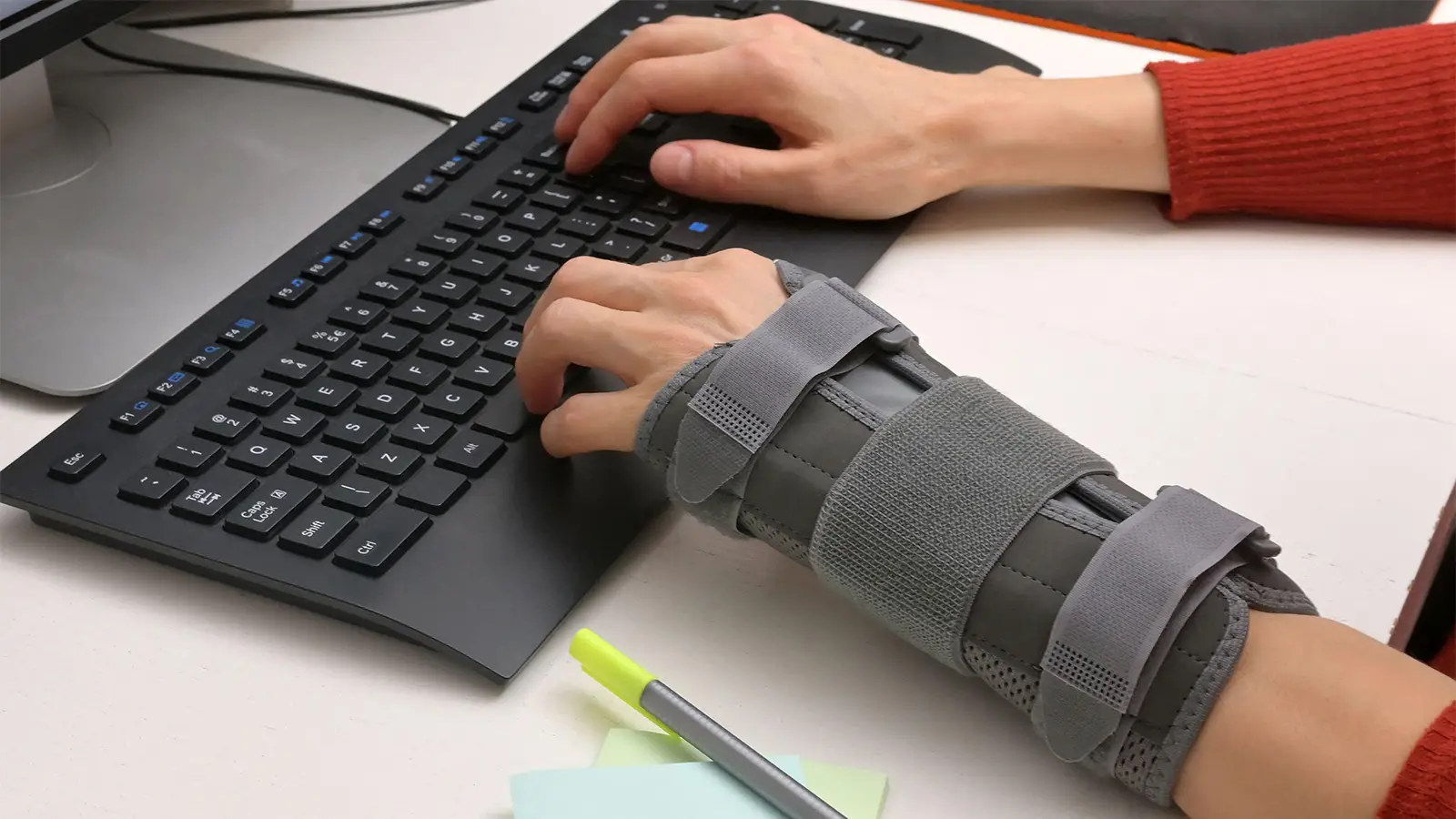
- Wrist splinting is widely used as a conservative treatment for carpal tunnel syndrome, but rigorous evidence for its effectiveness is scant.
- This trial randomized 142 patients to wear a rigid splint or a soft “placebo” bandage, with a composite symptom score at 12 weeks and progression to surgery within 1 year as co-primary outcomes.
- Symptom scores declined negligibly with both treatments, and a few more splinted patients required surgery relative to the placebo group; between-group differences for both outcomes did not reach statistical significance.
Patients with carpal tunnel syndrome (CTS) fared no better with wrist splinting, a widely prescribed conservative therapy, than with a simple soft wrap in a “placebo”-controlled randomized trial, researchers reported.
With CTS symptoms scored on a 5-point scale and 142 patients enrolled, those assigned to wear a rigid splint for 6-10 weeks saw a mean improvement of -0.36 points, compared with -0.28 in the soft-bandage group (P=0.478), according to Isam Atroshi, MD, PhD, of Skåne University Hospital in Hässleholm, Sweden, and colleagues.
In both cases, the improvement fell well short of the 0.7-point decrease set as the minimal clinically important change, the investigators indicated in their report appearing in NEJM Evidence.
They also found that a few more patients in the splinted group went on to require surgery within 1 year — 40 out of 70 compared with 37 of 72 in the “placebo” group. This difference, too, did not reach statistical significance.
Overall, Atroshi and colleagues concluded that splinting offered no real advantage over the soft bandage, although it seemed safe enough. “Placebo” is in quotes here because the researchers acknowledged that, while participants still had full range of wrist motion while wearing the wrap, “it could potentially exert other effects and therefore may not entirely represent a placebo treatment.”
In an accompanying editorial, two experts from Brigham and Women’s Hospital in Boston suggested a number of mechanisms whereby this inactive-seeming therapy may actually be therapeutic.
“Benefits from placebo may derive from a patient’s encounter with contextual components of medical therapies, from interpersonal interactions with clinicians to positive expectations generated by the symbolism of pharmaceuticals or medical devices,” wrote Karen C. Smith, PhD, and Jeffrey N. Katz, MD, MSc, both of Brigham and Women’s Hospital in Boston. “Symptom improvement from the placebo soft bandage could stem from the confidence gained from regular interactions with clinicians and trial staff, positive expectations created by the presence of the soft bandage, true mechanistic effects (e.g., the bandage acting as a reminder to limit wrist movement), or regression to the mean.”
They also wondered whether this could be a case in which physicians could reasonably and ethically prescribe a placebo treatment. “Historically, the use of placebos in clinical practice was considered to rely on deception, violating principles of patients’ autonomy and dignity,” Smith and Katz noted. “Yet, recent research on open-label placebos suggests that transparently prescribed placebo therapies can improve symptoms, and treatment with inert therapies occurs in routine clinical practice.”
As well, they observed, surveys of patients have indicated broad acceptability of placebos “depending on the scenario. In this context, placebo therapies merit consideration.” The pair also pointed out that costs wouldn’t be an important consideration in deciding between splinting and a soft wrap, since both are relatively cheap, and therefore either could be equally recommended. If the “active” treatment were a lot more expensive than the placebo, however, then the calculus would be quite different.
Study Details
Atroshi and colleagues recruited adult patients from southern Sweden meeting standard criteria for CTS, with duration of at least 1 month. Participants were randomized to wear either a rigid, metal-reinforced splint or a thin neoprene bandage that did not hinder wrist motion. These were worn for 6 weeks, and continued for an additional 4 weeks if symptoms did not improve sufficiently.
The co-primary outcome measures were the change from baseline in a six-item CTS symptom score at week 12 and the proportion of participants requiring surgery within 1 year. The symptom score covered pain, tingling, numbness, and other common complaints in CTS. A variety of secondary outcomes were also tracked, such as grip strength and nerve conduction test results. Both the splint and the soft bandage were equipped with a thermometer to measure skin temperature, which provided data on whether participants were actually wearing them.
Mean patient age was about 46, and more than 60% were women. In about two-thirds, the dominant hand was the one treated. Over 75% had endured symptoms for at least 6 months. At baseline, the CTS symptom score averaged about 2.8 on a scale of 1-5.
At week 6, the splinted group enjoyed a slight advantage, with scores declining by a mean of 0.24 points (95% CI 0.01-0.46), and therefore significantly better statistically if not clinically. However, at week 12 the difference shrank to meaninglessness. No difference in CTS scores was seen at week 52 either.
Surgical status at 1 year was determined for all participants, but 30 of the 142 originally randomized were not asked to return for a final physical exam, and 31 weren’t assessed for adverse events during follow-up. Most participants undergoing surgery did so in the first 6 months. Three patients in the soft-bandage group asked to be switched to the rigid splint during the treatment phase.
The temperature data suggested that compliance was about the same between the two groups during the first 6-week treatment phase, but then slipped somewhat more in the splint group than with the placebo wrap. Atroshi and colleagues also remarked that adherence “showed large variations among patients.”
Limitations included the relatively small sample size and its conduct in Sweden, where certain aspects of standard CTS care may differ from what is practiced elsewhere.
Source link : https://www.medpagetoday.com/orthopedics/orthopedics/120524
Author :
Publish date : 2026-03-27 16:04:00
Copyright for syndicated content belongs to the linked Source.