[ad_1]
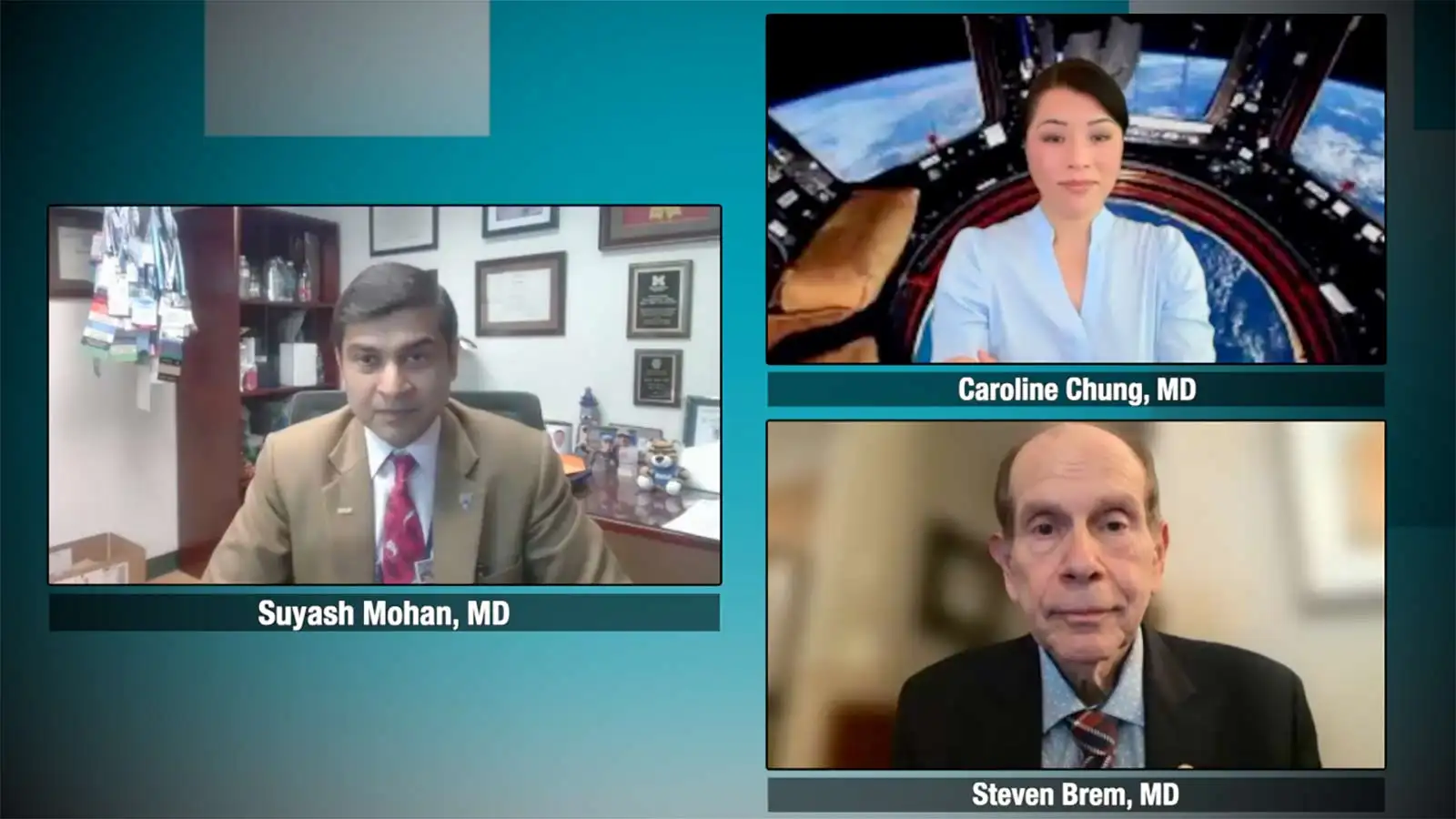
Following the American Society of Neuroradiology (ASNR) meeting, MedPage Today convened three leaders in neuro-oncology and brain tumor imaging for a virtual roundtable discussion on the evolving role of advanced MRI in brain tumor care. Moderator Suyash Mohan, MD, of the University of Pennsylvania in Philadelphia, is joined by Caroline Chung, MD, of the University of Texas MD Anderson Cancer Center in Houston, and Steven Brem, MD, also of the University of Pennsylvania.
In this second of four episodes, the panel explores whether advanced MRI and quantitative imaging can help move glioblastoma radiation planning beyond conventional anatomy-based margins. The discussion examines the need for standardized imaging biomarkers, the potential for biologically-guided dose escalation, and early findings from a machine learning-guided precision radiotherapy approach.
You can view the first video here.
Following is a transcript of their remarks:
Mohan: So let me ask you my second question, that we talked about heterogeneity of glioblastoma, but many of our treatment frameworks, especially in radiation oncology, are still built around anatomy-based target volumes and margins. Current guidelines-based target delineation still starts from postoperative contrast-enhancing residual tumor, surrounding FLAIR [fluid-attenuated inversion recovery] with standardized margins, which I agree is practical, is easily implementable across multiple institutes and enterprises, but obviously this is not the same as being biologically personalized. The uncomfortable question here is that how do we get beyond a one-size-fits-all approach? Dr. Chung?
Chung: I think it starts by understanding the disease. I think there have been many different imaging biomarkers that have been explored up to this point. Many papers that have been published around imaging features, whether it be functional diffusion maps from DWI [diffusion-weighted imaging] or incorporating multimodal imaging with amino acid PET with MRI and anatomical imaging, the challenge has been — and this is where we come back to the quantitative imaging space — if you take these measurements out of DWI and you have five different protocols to capture the DWI and you’re using completely different b-values in terms of DWI, are you actually measuring the same biological signal?
And so the quantitative piece is really to help us understand, because what you’re talking about is trying to tease out what is the biologically active component of the tumor. That’s what I’m looking for as a radiation oncologist, because we want to know what dose should we give to certain areas of tumor versus not.
And identifying that biological target is something that Cliff Ling actually published about well over a decade, almost two decades ago. And how do we get there is something that has been challenging us because we’ve all been acquiring images in a different way and not cross-calibrating.
I think there are now emerging technologies that could complement our efforts, for instance in-scan phantoms, that you can actually scan every single patient with that phantom to get absolute DWI measurements that are cross calibrated, just like running a control on your assays in the lab. So that could be one approach that we could take. There are other approaches in terms of better understanding the biology. So that’s one piece, the biological-targeting piece.
The second piece that we started to explore leveraging digital twins to explore all the different permutations is even with radiation delivery, we’ve gotten so capable of delivering precise radiotherapy that can dose paint where we want it to that we need to decide what we want to do with this capability.
And right now we have two extremes. One is radiosurgery on one extreme giving very, very high dose-ablative doses with high precision to smaller targets. And then the other extreme of conventional radiotherapy of 1.8 to 2 Gy per fraction for the most part. And everything in between has not really been explored extensively. There’s emerging hypofractionated trials, but again, we’re looking at the same dose each day. Is that really the best way to deliver radiation?
What if we combined these two? And there are now studies that are starting to explore what if you looked at all the other ranges in between? What does that do biologically, both to the tumor, but also now we’re realizing, as Dr. Brem mentioned with immunotherapy emerging, that role of the immune system in the cancer treatment is critical and we’re learning this more than ever.
And so how do we actually leverage this whole spectrum of radiation dose and delivery and giving low doses to some areas intentionally, very ultra-low doses to some areas versus very high doses to other areas to spark the immune reaction as well as stimulate immune response by the normal tissues is something that we’re just starting to scratch the surface at.
Mohan: I agree with you. And along the same lines, we had a similar hypothesis that if there is a way to predict where the peritumoral tissue is less likely to recur, and if we can come up with a strategy that we can spare those regions, and if we can predict ahead of time that this peritumoral tissue is more likely to recur or recur sooner than later, then can we intensify focally to those areas?
And along the same lines, we recently published results of our prospective clinical trial where we use machine learning approaches for, we call it personalized precision radiation therapy in newly diagnosed glioblastoma patients. And the idea was initially to show feasibility and also to show that these patients will not have significant grade 3 or higher toxicity. We were very pleased to share and present the results that the overall median progression-free survival, it increased to 24.4 months as opposed to 11.6 months in control patients.
And the most exciting piece that we found was that the overall survival increased to 35.4 months as compared to 17.7 months in controls, but clearly there was more radiation necrosis. So I think our results are promising but not yet a final answer. So for you, Dr. Chung, how do you interpret that kind of a signal as a radiation oncologist?
Chung: I mean, I think that one of the criticisms… I’ve submitted multiple grants on this idea of giving specific areas higher doses and dose escalating even for certain targets and dose sparing others. And some of the criticism that you get is that, oh, well, dose escalation has been tried and it’s failed. And I think that one of the things that I would caution around that statement is dose escalation failed at one point in time because of the way we were delivering the radiation.
Many of the dose-escalation trials failed because patients died of toxicity. To your point, we are still getting some radionecrosis when you dose escalate, but if we better understand the balance of that therapeutic ratio and we have better capabilities of high-precision delivery and we can actually meaningfully spare the respective tissues and incorporate radiobiology and incorporate that modeling, could we actually realize the gains of the dose escalation?
Because we never had the opportunity to in these prior trials. The patients died of massive toxicity because we were just giving higher doses of radiation to large volumes of brain. Some of these dose-escalations trials were done in the 3D-conformal era. You’re talking about beams of radiation that are so not complex that I had to, in my exams, hand draw where the doses were going to go. That’s how simple the dose planning was at one point in time. We had to figure out what angle of wedge we had to put in to make these two beams meet.
And so I think that dose escalating in an era where that was the treatment planning versus what we’re dealing with today are two potentially completely different worlds and we need to start re-exploring some of these appreciating the advances in the technology that we actually are able to utilize for our patients.
[ad_2]
Source link : https://www.medpagetoday.com/meetingcoverage/asnrexpertvideoroundtable/121915
Author :
Publish date : 2026-06-24 20:29:00
Copyright for syndicated content belongs to the linked Source.